Anyloan Australia Personal Loan Repayment Calculator
Calculate repayments with our Personal Loan Calculator. Compare loan terms, view repayment schedules, and plan your personal finance with confidence.
Calculator results are estimates based on the inputs and assumptions used and are provided for general information only. They are not quotes, offers, approval, eligibility decisions or personalised recommendations, and do not indicate that a lender will provide credit. Actual repayments and costs may differ.
Personal Loan Details:
Important!
Personal Loan Interest Rates differ from lender to lender and will depend on your individual circumstances (credit history, employment status, age, etc.).
Personal Loan Amortisation Calculator
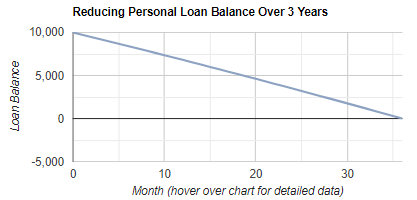
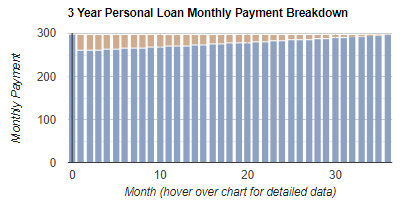
The following amortisation graphs detail month-by-month data on the progress of the proposed loan. The first chart below examines the reducing loan balance over the course of the finance contract term. The second graph illustrates the portion of each monthly repayment allocated to payment of interest vs principal reduction.
How to use our Personal Loan Repayment Calculator
Our Personal Loan Repayment Calculator helps you estimate your ongoing loan repayments and the total cost of borrowing before you apply. By adjusting the loan amount, loan term and interest rate, you can compare scenarios and choose a repayment level that better fits your budget. It also provides an amortisation view so you can see how each repayment is split between interest and principal over time.
Important note for ASIC compliance: this calculator provides general information only and does not take into account your objectives, financial situation or needs. Results are estimates and may not include lender fees, comparison rates, commissions, insurance, redraw features, or changes to your interest rate. Always check a lender’s final quote and loan contract before deciding.
How to complete the form for the best result
1. Loan Amount Required: Enter the total amount you want to borrow in Australian dollars as a whole number (no decimals or commas). Use the amount you actually need, not the maximum you might be approved for, to avoid overpaying interest.
2. Term of Loan: Select the number of years you plan to repay the loan over. A longer term can reduce the monthly repayment, but typically increases the total interest paid over the life of the loan.
3. Interest Rate: Choose an annual interest rate for the simulation. If you have a lender quote, use that rate. If not, test a conservative range to understand best case and worst case outcomes.
4. Calculate: Click the calculate button to generate your results.
How to interpret the results
1. Repayment estimate: Treat the repayment figure as your baseline commitment. Stress-test your budget by increasing the rate or shortening the term to see if repayments remain affordable.
2. Amortisation and graphs: Review the month-by-month amortisation view and charts to understand how the balance reduces and how early repayments often include a higher interest portion, shifting toward more principal over time.
3. Compare scenarios: Re-run the calculator with different terms and rates to balance affordability (cash flow) against total interest (overall cost).
A solid financial plan helps you understand where your money is going, set practical goals and prepare for major life decisions such as buying a home, purchasing a car, investing, protecting your family or planning for retirement. This guide explains the main building blocks of financial planning in an Australian context, without replacing personalised financial advice. - read more
Understanding your borrowing power is an essential step for anyone looking to take out a loan. This concept represents the amount of money you're eligible to borrow from a lender, whether it’s for purchasing a home, a car, or investing in your future. Knowing your borrowing power not only sets realistic expectations but also guides you in financial planning and budgeting for your loan repayments. - read more
Navigating the complexities of loan repayments can be daunting, but understanding the components and their impact on our financial health is essential. In Australia, a wise approach to loan repayment not only alleviates financial strain but directly influences our credit scores and future borrowing capacity. - read more
Personal loans have become an increasingly popular financial tool among millennials in Australia. As the cost of living rises and life goals such as buying a home or pursuing higher education loom on the horizon, personal loans offer a means to achieve these goals with more immediate access to funds. However, the array of options and terms can be bewildering, making it crucial for young adults to approach borrowing with a prudent mindset. - read more
The Reserve Bank of Australia’s October 2026 Financial Stability Review gives borrowers a mixed but useful message: the financial system remains broadly resilient, yet cost pressures, hardship requests and sector-specific business stress are still important warning signs for households and SMEs planning their next finance decision. - read more
Recent personal and vehicle loan rate updates are reinforcing a practical message for Australian borrowers: the reason you borrow, the asset involved and the strength of your application can still make a meaningful difference to the price you are offered. - read more
The latest Reserve Bank lending-rate data gives Australian small business owners another reason to look beyond the first offer on the table. While business credit has continued to expand through 2026, the price paid by smaller borrowers remains highly dependent on loan structure, security, trading history and lender appetite. - read more
The Reserve Bank’s latest financial aggregates add another chapter to the borrowing story that has been building through 2026. The July update indicates that private sector credit is still expanding, with business lending remaining an important source of momentum. For SMEs, sole traders and self-employed borrowers, this extends the pattern seen in the earlier June credit data: demand for funding has not disappeared, even while interest rates and lender scrutiny continue to shape approval outcomes. - read more
The Reserve Bank’s latest meeting minutes have added more detail to the message borrowers heard after the earlier August rate decision: policy makers are not yet ready to declare victory over inflation, even if some parts of the economy are clearly slowing. For households, sole traders and SMEs, that means borrowing plans still need to be built around current lending conditions rather than expectations of a quick fall in rates. - read more
All finance quotes are provided free (via our secure server) and without
obligation. We respect your
privacy.
Knowledgebase
Mortgage: A loan in which the borrower (the mortgagor) offers a property and land as security to the lender (the mortgagee) until the loan is repaid. Repayments of the loan are usually made on a monthly basis over a long period of time, typically 25 years.