Calculate motorcycle loan repayments in seconds with our Bike Loan Calculator. Compare finance options and plan your ride with confidence.
Calculator results are estimates based on the inputs and assumptions used and are provided for general information only. They are not quotes, offers, approval, eligibility decisions or personalised recommendations, and do not indicate that a lender will provide credit. Actual repayments and costs may differ.
Bike Loan Details:
Important!
Bike Loan Interest Rates differ from lender to lender and will depend on your individual circumstances (credit history, employment status, age, etc.).
Bike Loan Amortisation Calculator
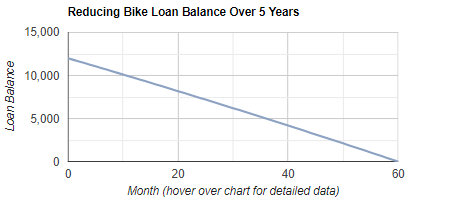
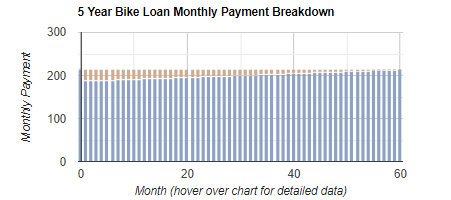
The following amortisation graphs detail month-by-month data on the progress of the proposed loan. The first chart below examines the reducing loan balance over the course of the finance contract term. The second graph illustrates the portion of each monthly repayment allocated to payment of interest vs principal reduction.
How to use our Bike Loan Repayment Calculator
Our Bike Loan Repayment Calculator is designed to estimate your motorcycle loan repayments in seconds, so you can compare bike finance options and plan your budget before you commit. It is important because small changes to loan size, term length and interest rate can materially change your monthly repayment and the total interest you pay over the life of the loan.
This calculator provides estimates only and is not personal financial advice. Results do not take into account your objectives, financial situation or needs. Interest rates and fees vary by lender and your individual circumstances, and your final rate can only be confirmed after an application is assessed.
How to complete the form for the best result:
1. Purchase Price
Enter the bike purchase price as a whole number (no dots or commas). If you expect to borrow extra for on-road costs such as stamp duty, registration or insurance, include those amounts in the figure you enter so the estimate better reflects your likely loan amount.
2. Deposit or Trade-in Value (if applicable)
Enter your deposit or trade-in value as a whole number. If you have no deposit, enter 0. A higher deposit generally reduces the amount borrowed and can reduce interest paid over time.
3. Term of Loan (Years)
Select a term between 1 and 7 years. Longer terms typically reduce monthly repayments but can increase the overall cost of the loan due to more interest over time. Choose a term that fits your cash flow, not just the lowest repayment.
4. Interest Rate (% per annum)
Select an interest rate for the simulation. If you are unsure, test a conservative higher rate to see whether repayments remain affordable.
5. Calculate
Click calculate to generate your estimated repayment and amortisation visuals.
How to interpret the results:
1. Repayment estimate
Use the repayment figure as a starting point for budgeting, then stress-test by increasing the rate or reducing your deposit to see how sensitive repayments are.
2. Amortisation graphs
Review the loan balance chart to understand how quickly you reduce what you owe, and the interest versus principal chart to see how much of each repayment goes to interest compared with reducing the loan balance over time.
In today's digital age, the landscape of borrowing has evolved with the emergence of online loans. The convenience and accessibility offered by online lenders have made them an increasingly popular choice for Australians seeking financial assistance. However, it is essential to approach online borrowing with caution and make informed decisions to ensure smart borrowing practices. - read more
Getting your loan approved is a significant milestone, but it also opens the door to many new responsibilities. Proper management of your finances after loan approval is crucial to avoid common pitfalls that could derail your financial stability. - read more
Acquiring a loan as a self-employed individual in Australia can often feel like navigating a labyrinth. Without the regular pay cheques and conventional financial documentation typically provided by salaried employees, self-employed Australians face unique challenges in proving their creditworthiness to lenders. - read more
Starting a business is an exciting venture, often filled with dreams and aspirations of growing a successful enterprise. For many first-time entrepreneurs, securing a business loan can be a crucial step in turning these dreams into reality. Business loans provide the necessary funds for growth and expansion, enabling startups to invest in equipment, hire employees, and expand marketing efforts. - read more
Understanding your borrowing power is an essential step for anyone looking to take out a loan. This concept represents the amount of money you're eligible to borrow from a lender, whether it’s for purchasing a home, a car, or investing in your future. Knowing your borrowing power not only sets realistic expectations but also guides you in financial planning and budgeting for your loan repayments. - read more
The Reserve Bank of Australia’s October 2026 Financial Stability Review gives borrowers a mixed but useful message: the financial system remains broadly resilient, yet cost pressures, hardship requests and sector-specific business stress are still important warning signs for households and SMEs planning their next finance decision. - read more
Recent personal and vehicle loan rate updates are reinforcing a practical message for Australian borrowers: the reason you borrow, the asset involved and the strength of your application can still make a meaningful difference to the price you are offered. - read more
The latest Reserve Bank lending-rate data gives Australian small business owners another reason to look beyond the first offer on the table. While business credit has continued to expand through 2026, the price paid by smaller borrowers remains highly dependent on loan structure, security, trading history and lender appetite. - read more
The Reserve Bank’s latest financial aggregates add another chapter to the borrowing story that has been building through 2026. The July update indicates that private sector credit is still expanding, with business lending remaining an important source of momentum. For SMEs, sole traders and self-employed borrowers, this extends the pattern seen in the earlier June credit data: demand for funding has not disappeared, even while interest rates and lender scrutiny continue to shape approval outcomes. - read more
The Reserve Bank’s latest meeting minutes have added more detail to the message borrowers heard after the earlier August rate decision: policy makers are not yet ready to declare victory over inflation, even if some parts of the economy are clearly slowing. For households, sole traders and SMEs, that means borrowing plans still need to be built around current lending conditions rather than expectations of a quick fall in rates. - read more