Use our Truck Loan Calculator to estimate repayments, compare finance options, and plan your purchase with ease. Fast, simple, and tailored for Australian businesses and drivers.
Calculator results are estimates only and not quotes. Actual quotes will be provided by licensed brokers after you submit an enquiry.
Truck Loan Details:
Important!
Truck Loan Interest Rates differ from lender to lender and will depend on your individual circumstances (credit history, employment status, age, etc.). To find out if you qualify ... and for a free, personalised interest rate and repayment quote,
please CLICK HERE
Truck Loan Amortisation Calculator
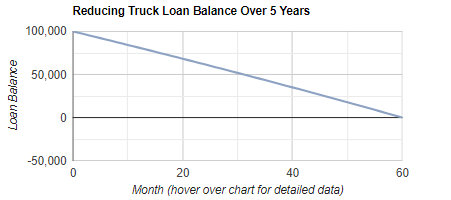
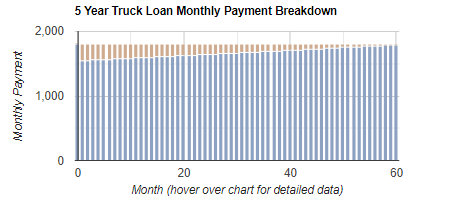
The following amortisation graphs detail month-by-month data on the progress of the proposed loan. The first chart below examines the reducing loan balance over the course of the finance contract term. The second graph illustrates the portion of each monthly repayment allocated to payment of interest vs principal reduction.
How to use our Truck Loan Repayment Calculator
Our Truck Loan Repayment Calculator helps Australian drivers and businesses estimate loan repayments before you commit. It is designed to support budgeting, cash flow planning, and comparing truck finance scenarios by showing how changes to price, deposit, term, and interest rate can affect your repayments and total interest cost.
How to complete the calculator for the most accurate estimate
1. Purchase Price
Enter the total purchase price of the truck you plan to finance. Consider including eligible on-road and purchase-related costs that may be financed (for example registration, insurance, or other costs where applicable). Use whole numbers only, without commas or decimals.
2. Deposit or Trade-in Value
If you are paying an upfront deposit or using a trade-in, enter that amount here. This reduces the amount you need to borrow and can lower repayments and total interest. Use whole numbers only.
3. Term of Loan (Years)
Select the loan term in years. In general, a longer term can reduce the periodic repayment but may increase the total interest paid over the life of the loan. Choose a term that suits your expected truck usage and business cash flow.
4. Interest Rate (Percent per annum)
Select an interest rate to model your scenario. Rates vary by lender and borrower circumstances, so it can be helpful to test a conservative rate as well as an optimistic one.
5. Calculate
Select calculate to generate your repayment estimate and repayment breakdown visuals.
How to interpret your results
1. Repayment estimate
Use this as a guide to affordability and budgeting. If the repayment is tight, test a higher deposit, shorter term, or different interest rate.
2. Amortisation and graphs
Review how the loan balance reduces over time, and how each repayment typically shifts from mostly interest early on to more principal later. This can help with planning for refinancing, early payout, or upgrade timing.
ASIC compliance note: This calculator provides information only and is not financial or credit advice. Results are estimates and may not include all fees, charges, taxes, residuals or balloon payments. Consider your objectives and financial situation, and seek independent advice or a lender quote before proceeding.
Smart borrowing is crucial for individuals and businesses in Australia to manage their financial goals effectively. With a well thought-out borrowing strategy, you can optimize your finances, minimize costs, and achieve your financial objectives. - read more
Loan calculators are powerful tools that assist borrowers in estimating their potential loan payments. By inputting variables such as loan amount, interest rate, and loan term, these calculators provide insight into what one's monthly repayments might look like. This can be invaluable for budgeting and financial planning purposes. - read more
Loan management skills are crucial for individuals and families in Australia, as they play a vital role in managing finances and achieving financial stability. Effective loan management enables individuals to make sound financial decisions and avoid falling into debt traps. This article aims to highlight the importance of acquiring loan management skills and how it can benefit Australians. - read more
Starting a business is an exciting venture, often filled with dreams and aspirations of growing a successful enterprise. For many first-time entrepreneurs, securing a business loan can be a crucial step in turning these dreams into reality. Business loans provide the necessary funds for growth and expansion, enabling startups to invest in equipment, hire employees, and expand marketing efforts. - read more
The latest Reserve Bank lending-rate data gives Australian small business owners another reason to look beyond the first offer on the table. While business credit has continued to expand through 2026, the price paid by smaller borrowers remains highly dependent on loan structure, security, trading history and lender appetite. - read more
The Reserve Bank’s latest financial aggregates add another chapter to the borrowing story that has been building through 2026. The July update indicates that private sector credit is still expanding, with business lending remaining an important source of momentum. For SMEs, sole traders and self-employed borrowers, this extends the pattern seen in the earlier June credit data: demand for funding has not disappeared, even while interest rates and lender scrutiny continue to shape approval outcomes. - read more
The Reserve Bank’s latest meeting minutes have added more detail to the message borrowers heard after the earlier August rate decision: policy makers are not yet ready to declare victory over inflation, even if some parts of the economy are clearly slowing. For households, sole traders and SMEs, that means borrowing plans still need to be built around current lending conditions rather than expectations of a quick fall in rates. - read more
The Reserve Bank of Australia’s August decision to leave the cash rate unchanged at 4.35% keeps a familiar message in place for Australian borrowers: relief may come eventually, but loan decisions still need to be made on today’s numbers. For households, sole traders and SMEs, the practical issue is not only where rates sit now, but how lenders assess affordability while policy remains restrictive. - read more
The latest Reserve Bank financial aggregates extend a pattern that has been building for several months: Australian businesses are still leaning on credit, even while borrowing costs remain elevated and lenders continue to scrutinise applications closely. Private sector credit continued to grow over the month and across the year, with business lending again a key contributor to overall momentum. - read more